
The distinction matters. A fact witness ordinarily testifies about events the witness personally observed. An expert witness may offer specialized opinions based on professional training and experience.
Although Rattner appeared as a fact witness, her testimony extended far beyond simply describing what occurred during treatment.
1. This Was My Private Civil Trial
Rattner did not testify in a criminal prosecution, a child-protection proceeding, or a professional disciplinary hearing.
She testified during my private civil lawsuit against Raymond Knutsen.
Rattner was not a plaintiff or defendant. She had no firsthand involvement in the events underlying the lawsuit and no personal claim at issue in the case.
Her connection to the litigation arose from the trauma treatment she had provided to my son.
2. She Testified as a Fact Witness, Not a Designated Expert Witness
The deadline for disclosing expert witnesses had passed. Rattner was therefore presented to the court as a fact witness, not as a properly designated expert witness.
That procedural label should have limited her testimony to facts within her personal knowledge, including what she did, what she observed, and what occurred during the treatment sessions.
It did not transform her into an independent forensic evaluator, nor did it establish that she had conducted the investigation ordinarily expected before offering conclusions about disputed allegations.
By her own testimony, Rattner was acting as a trauma therapist rather than a forensic evaluator.
Q. And there’s a difference between the role of a therapist and the role of a forensic evaluator, correct?
A. Yes.
Q. And which role did you have in this case?
A. I’m a trauma therapist.
3. Rattner Was Compensated for Her Participation
Rattner was not a disinterested observer who happened to possess relevant information.
She had been retained and paid in connection with her work involving my son, and she was compensated for her participation in the civil trial.
Compensation alone does not automatically invalidate a witness’s testimony. Professional witnesses and experts are routinely paid for their time.
The important question is whether the witness maintains the independence, objectivity, and professional boundaries expected when offering opinions that may influence a court.
That question becomes especially important when the witness:
- was retained by one side;
- received information primarily from that side;
- never interviewed the opposing parent;
- did not independently investigate the allegations;
- knew the allegations had not been substantiated by DCF; and
- nevertheless offered opinions supporting continued separation between a mother and her child.
4. “I’m Not an Accountant”
During questioning about the financial arrangement surrounding her work and testimony, Rattner attempted to distance herself from the subject of payment.
A. I’m not an accountant.
The question was not whether Rattner personally maintained accounting records. The issue was whether she had been paid, by whom, and for what services.
Those were relevant questions because she was appearing in a civil lawsuit in which she was not a party, had no personal claim, and had been brought into the case by one side.
Her response did not change the underlying fact that compensation formed part of her relationship to the litigation.
5. Her Testimony Went Beyond Recounting Facts
Although Rattner testified as a fact witness, she did not limit herself to describing appointment dates, treatment methods, statements made during sessions, or her own direct observations.
She offered opinions about:
- whether abuse had occurred;
- the nature and severity of the alleged trauma;
- the meaning of my son’s reported statements;
- the reliability of the material she treated; and
- whether reunification between my son and me should occur.
At the conclusion of cross-examination, she was asked whether my son should participate in reunification therapy with me.
Q. By your standard should he be able to have reunification therapy with Karen Cegalis?
A. No.
That was not merely a factual description of treatment. It was a professional opinion with potentially permanent consequences for a parent and child.
6. The Question Is Whether Her Opinions Were Independent
The central issue is not simply that Rattner was paid.
The issue is whether the opinions she offered reflected the independence expected of a professional witness.
By her own testimony:
- she was a treating therapist rather than a forensic evaluator;
- she did not investigate whether the allegations were true;
- she never interviewed me;
- she did not review significant contradictory information;
- she did not know the national standards for interviewing children;
- my son’s stepmother attended all thirteen treatment days;
- she knew DCF had not substantiated the allegations; and
- she nevertheless recommended against reunification.
She entered my civil trial as a compensated fact witness with no personal stake in the lawsuit, then offered conclusions that resembled expert opinions despite the absence of an independent forensic investigation.
Readers can review the certified transcript and decide for themselves how much weight those opinions deserved.
Why the Financial Relationship Matters
Courts depend on witnesses to identify the limits of their knowledge and professional role.
Rattner was permitted to testify as a fact witness after the expert-witness disclosure deadline had passed. She was compensated for participating in a private civil trial in which she was not a party and had no personal stake.
Yet her testimony extended beyond factual observations and included consequential opinions about disputed abuse allegations and whether a mother should be permitted to reunify with her child.
The combination of compensation, one-sided information, limited investigation, fact-witness status, and sweeping professional conclusions is part of the record.
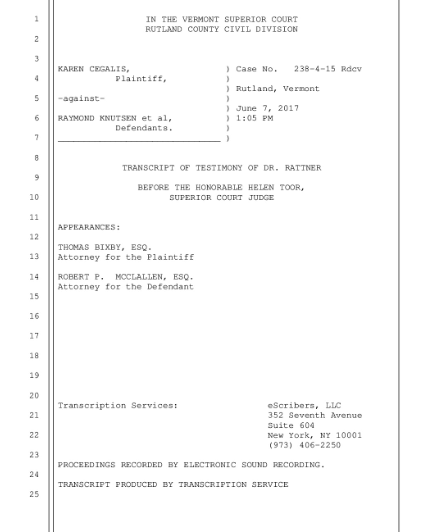
Read the certified June 7, 2017 transcript of Bambi Rattner’s testimony.
