
Raymond Knutsen’s motion to dismiss argued that Vermont sought to discipline him under recordkeeping standards that were not mandatory when the veterinary care occurred.
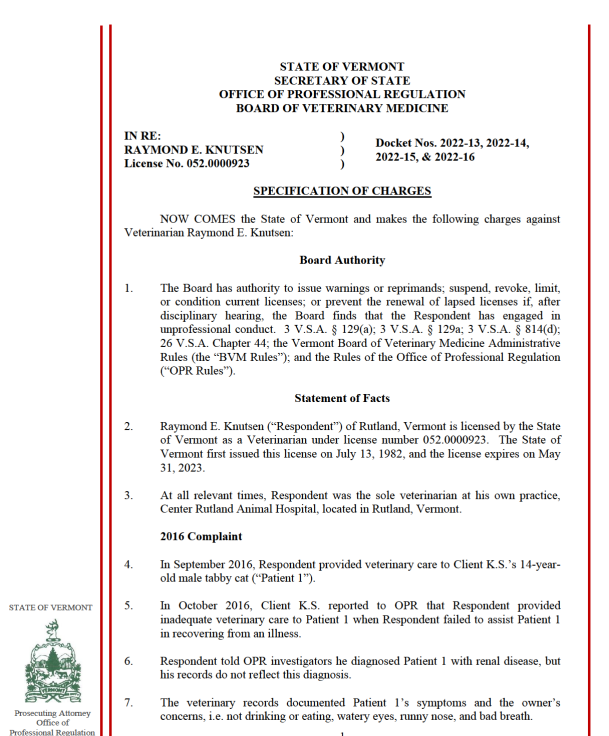
In February 2022, the Vermont Office of Professional Regulation brought four consolidated disciplinary cases against veterinarian Raymond E. Knutsen.
The State’s Specification of Charges described complaints involving four animals treated between 2016 and 2020. The State alleged that Knutsen provided unsafe or unacceptable patient care, failed to conform to prevailing professional standards, violated Vermont’s rabies vaccination rules, and failed to exercise independent professional judgment.
A central issue throughout the filing was the condition of Knutsen’s veterinary records.
The State alleged that the records frequently failed to show whether an animal had been examined, what diagnosis had been made, how clinical information had been interpreted, what treatment had been provided, or what follow-up care had been recommended.
But in a November 23, 2022 motion to dismiss, Knutsen’s attorney raised a different question:
Were the recordkeeping practices cited by the State actually mandatory when the alleged conduct occurred?
Four Complaints Spanning Several Years
The disciplinary charges combined four complaints involving veterinary care provided between 2016 and 2020.
The 2016 Complaint
The first complaint involved a 14-year-old male cat.
According to the State, the cat was treated for symptoms that included difficulty eating, watery eyes, a runny nose, and bad breath. The records included references to stomatitis, antibiotics, and a dental procedure.
The State alleged that the records did not adequately describe the cat’s condition, what dental work was performed, or the animal’s condition when released.
The owner later brought the cat to another veterinary office, where he was reportedly diagnosed with corneal ulcers, an upper respiratory infection, dehydration, and eye ulcers. The cat was euthanized on September 15, 2016.
The 2017 Complaint
The second complaint involved a three-year-old female cat that received rabies and feline distemper vaccinations.
The State alleged that a veterinary technician administered the vaccines without an examination by Knutsen and without his direct supervision.
The State also alleged that the veterinary record did not adequately document an examination, diagnosis, treatment, or information communicated to the owner.
The 2018 Complaint
The third complaint involved a six-year-old female cat brought to Knutsen’s office because she had blood in her urine, was lethargic, and was not eating or drinking normally.
The records documented urine test results, antibiotics, and prescription food recommendations.
The State alleged that the records did not include physical examination findings, a clear diagnosis, interpretation of the clinical information, or an adequate follow-up plan.
When the cat did not improve, the owner took her to another veterinarian, who diagnosed renal failure.
The 2021 Complaint
The fourth complaint concerned care provided in November 2020 to a one-year-old female dog.
The State characterized portions of the dog’s records as illegible and inadequate. It alleged that the records did not clearly document an examination, treatment, diagnostic reasoning, medication risks, or communication with the owner.
The dog was subsequently taken to another veterinarian, where an ultrasound reportedly revealed an intestinal blockage. She was ultimately euthanized.
What the State Alleged
Based on the four complaints, the State accused Knutsen of four categories of professional misconduct:
- Providing unsafe or unacceptable patient care.
- Failing to conform to essential standards of acceptable and prevailing veterinary practice.
- Failing to comply with Vermont’s rules governing rabies vaccinations.
- Failing to exercise independent professional judgment when necessary to avoid conduct considered repugnant to the profession.
The State asked the Vermont Board of Veterinary Medicine to warn, reprimand, suspend, revoke, restrict, or otherwise discipline Knutsen’s veterinary license.
Knutsen Moves to Dismiss the Charges
Knutsen denied that the allegations established professional misconduct and asked the Board to dismiss all four charges.
His motion did not simply argue that his records were sufficient. Instead, it challenged whether the State had identified a legally enforceable recordkeeping requirement that applied when the care was provided.
The motion acknowledged that the records were the primary focus of the State’s case. It then distinguished between professional recommendations and legally mandatory requirements.
The Earlier Rule Said Veterinarians “Should” Keep Certain Records
Knutsen’s attorney cited the version of Vermont Board of Veterinary Medicine Rule 3.13 that was in effect when the alleged conduct occurred.
That rule stated that the Board recommended that veterinary records include information such as:
- Client and patient information.
- Examinations and consultations.
- A thorough patient history.
- Identification of the person providing services.
- Records organized in a SOAP-style format.
The motion argued that these provisions were advisory recommendations rather than mandatory legal requirements.
According to the defense, the State was attempting to transform recommended practices into enforceable rules after the alleged conduct had already occurred.
New Mandatory Rules Took Effect in July 2022
The motion contrasted the earlier language with new veterinary rules that became effective on July 15, 2022.
Under the newer rules, a veterinarian was required to maintain an individual record for each companion animal. The record was required to include items such as:
- A complete patient history.
- Individualized entries for assessments and treatment.
- Consultations and procedures.
- Interventions, diagnoses, and plans.
- The identity of every person providing a service.
The defense emphasized the change from language stating that veterinarians should follow certain practices to language stating that they shall maintain specified records.
Knutsen’s position was that the Board could not use the later mandatory standards to establish misconduct involving care provided years earlier.
The Defense Accused the State of Using Vague Disciplinary Provisions
Because the earlier recordkeeping rule was framed as a recommendation, the State relied on broader statutory provisions concerning competent care, prevailing professional standards, and independent professional judgment.
Knutsen’s motion argued that this approach was legally improper.
The defense contended that the State could not use broad professional misconduct statutes to enforce specific recordkeeping expectations that the Board itself had not yet made mandatory.
The motion described the State’s approach as an attempt to impose a higher standard than the rules required at the time.
The Rabies Vaccination Charge
The fourth disciplinary allegation presented a separate issue.
The State alleged that a veterinary technician administered a rabies vaccine without an examination or direct supervision from Knutsen.
Knutsen’s motion argued that the technician acted without his approval and outside his control.
The defense maintained that a veterinarian should not automatically be held professionally responsible for the unilateral conduct of an employee, particularly where the State allegedly possessed evidence supporting Knutsen’s account.
The motion therefore asked the Board to dismiss the vaccination-related charge as well.
What the Motion Asked the Board to Do
Knutsen requested dismissal of the charges involving recordkeeping on the grounds that:
- The applicable rules recommended recordkeeping practices but did not mandate them.
- The State relied on broad professional conduct statutes instead of a specific mandatory recordkeeping rule.
- The Board did not adopt detailed mandatory recordkeeping requirements until July 2022.
- The newer requirements should not be applied to conduct that occurred between 2016 and 2020.
He separately requested dismissal of the rabies vaccination charge, arguing that the veterinary technician acted independently and without authorization.
Why the Timing Matters
The motion raised an important distinction between poor documentation and legally punishable professional misconduct.
A record may be incomplete, unclear, or difficult to interpret. That does not automatically answer the separate legal question of whether the record violated a mandatory rule in effect at the time.
The State’s position was that the records demonstrated unsafe care and a failure to comply with accepted professional standards.
Knutsen’s position was that the State was attempting to discipline him for failing to follow recordkeeping practices that were recommended, but not legally required.
The motion to dismiss asked the Board to resolve that legal question before proceeding to a full disciplinary hearing.
Read the Public Records
The documents discussed in this article include the State’s Specification of Charges, scheduling filings, Knutsen’s Motion to Dismiss, and related procedural documents from the Vermont Office of Professional Regulation.
Editor’s Note: This article summarizes allegations and arguments contained in public disciplinary filings. Allegations in a Specification of Charges are not findings of misconduct. A motion filed by a respondent presents that party’s legal arguments and is not itself a ruling by the Board.